
Lever Butterfly Valve for Fire Protection — Wafer Type DN50–DN150
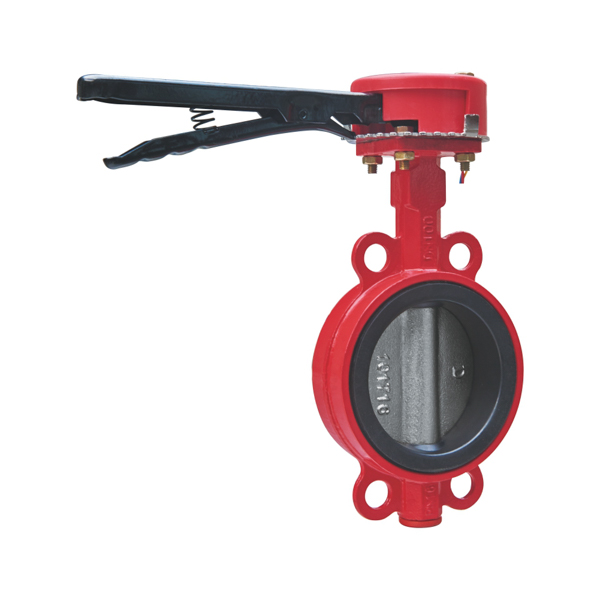
The CA-FIRE lever butterfly valve (ZSDF7-S / ZSXDF7-S series) is a quarter-turn handle operated wafer butterfly valve designed for fire sprinkler branch lines, small risers, and auxiliary isolation points. Available in two variants — with tamper switch (ZSXDF7-S) and without tamper switch (ZSDF7-S) — covering DN50 through DN150, rated at 1.6 MPa working pressure.
The lever butterfly valve is the fastest manual isolation valve in fire protection service. A single quarter-turn of the handle moves the disc from fully open to fully closed — or fully closed to fully open — in under two seconds. This makes it the preferred choice for branch line isolations, drain valve stations, and test and drain assemblies where speed of operation matters more than torque reduction. For larger valves DN100 and above on fire water mains, see the Gear Operated Butterfly Valve page.
This page covers wafer type lever operated butterfly valves (ZSDF7-S / ZSXDF7-S), DN50–DN150. For grooved Victaulic-compatible butterfly valves, see the Grooved Butterfly Valve page. For hazardous area Ex-certified valves, see the Explosion Proof Butterfly Valve page.
Key Features of the ZSDF7-S / ZSXDF7-S Lever Butterfly Valve
- Quarter-turn lever handle— full open to full closed in a single 90° movement. No handwheel turns required. Ideal for emergency isolation and frequent test-and-drain operations.
- Two model variants:ZSXDF7-S with built-in DC24V tamper switch for electrically supervised fire systems, and ZSDF7-S without switch for unsupervised zones — same body and seat, different supervision method.
- ZSXDF7-S tamper switchoutputs open/closed position signal directly to the fire alarm control panel (FACP), satisfying NFPA 72 Chapter 17 supervisory signal requirements without additional components.
- Compact and lightweight— lever handle adds minimal weight versus the worm gear housing on gear operated models. Preferred in suspended ceiling voids and riser shaft installations where space is constrained.
- Wafer type installationbetween ANSI 150 / DIN PN16 / GB PN16 flanges. Face-to-face 45–60 mm for DN50–DN150 — shorter than grooved equivalents.
- Cast iron GGG40 or stainless steel SS316 body— SS316 recommended for foam concentrate lines, seawater cooling, and coastal installations.
- EPDM resilient seat— compatible with water, AFFF foam, AR-AFFF, and 3% protein foam at 4–80°C operating temperature.
- Optional lever padlock position— a padlock hole in the lever accepts standard padlock (shackle ≤ 8 mm) to lock the valve open, satisfying NFPA 13 Section 8.16.1(2) physical supervision requirement.
- Compliant with GB 5135.13(signal butterfly valve) and GB 5135.2 (non-signal butterfly valve) Chinese national fire protection valve standards.
Technical Specifications — ZSXDF7-S vs. ZSDF7-S
The table below compares both lever butterfly valve models. Both share the same wafer body, EPDM seat, and pressure ratings. The tamper switch is the only differentiating component.
| Parameter | ZSXDF7-S (With Signal) | ZSDF7-S (No Signal) |
| Model Number | ZSXDF7-S-Q-50-150-16 | ZSDF7-S-Q-50-150-16 |
| Nominal Diameter | DN50 / DN65 / DN80 / DN100 / DN125 / DN150 | DN50 / DN65 / DN80 / DN100 / DN125 / DN150 |
| Working Pressure | 1.6 MPa | 1.6 MPa |
| Strength Test | 6.4 MPa | 6.4 MPa |
| Seal Test | 3.2 MPa | 3.2 MPa |
| Media | Water, foam-water mixture | Water, foam-water mixture |
| Actuator | Lever handle (手柄), quarter-turn | Lever handle (手柄), quarter-turn |
| Tamper Switch | DC24V 0.5A (open/closed) | None |
| Signal Output | Yes — to FACP | No |
| Body Material | Cast iron GGG40 / SS316 | Cast iron GGG40 / SS316 |
| Connection | Wafer (between flanges) | Wafer (between flanges) |
| Temperature Range | 0–80°C | 4–70°C |
| Locking | Optional padlock on lever | Optional padlock on lever |
| Typical Use | Branch line supervision, small riser supervision | Drain valves, test lines, non-supervised branches |
Structural Dimensions — Wafer Type Face-to-Face Length
The lever butterfly valve is available in DN50 through DN150. For DN200 and above, the gear operated butterfly valve is recommended due to higher operating torque requirements at larger disc diameters.
| DN (mm) | 50 | 65 | 80 | 100 | 125 | 150 |
| Face-to-Face (mm) | 45 | 50 | 50 | 55 | 60 | 60 |
How the Lever Butterfly Valve Works
The lever butterfly valve uses direct mechanical linkage between the handle and valve stem — no gearing, no intermediate mechanism. This makes it the simplest and fastest operating butterfly valve in fire protection service:
- Quarter-turn operation: The lever handle connects directly to the valve stem. Rotating the lever 90° clockwise closes the valve (disc perpendicular to flow); 90° counterclockwise opens it (disc parallel to flow). The lever position is a direct visual indicator of valve status — lever parallel to pipe = open; lever perpendicular = closed.
- Position detents: Travel stops machined into the valve body prevent over-rotation of the disc beyond 90°, protecting the EPDM seat from shear damage. A detent notch locks the lever in both the full-open and full-closed positions to prevent unintended movement from vibration.
- Tamper switch activation (ZSXDF7-S only): A cam follower on the valve stem contacts the supervisory switch microswitch. In the fully open position, the switch outputs a continuous ‘OPEN’ supervisory signal (DC24V) to the FACP. Moving the lever away from full-open by as little as 1–2° changes the switch state and triggers a ‘TAMPER’ supervisory alarm per NFPA 72 Chapter 17 within seconds.
- Lever locking: A hole through the lever shank accepts a standard padlock when the valve is in the full-open position. The padlock prevents the lever from being rotated to the closed position without removing the lock. This satisfies NFPA 13 Section 8.16.1(2) physical supervision (lock-open) as an alternative to electronic tamper switch supervision.
- Torque characteristics: The lever butterfly valve requires higher hand torque than the gear operated equivalent for the same valve size. Typical break torque (cracking open against 1.6 MPa) for DN150 is approximately 35–45 Nm — manageable for one-handed operation by maintenance personnel. For DN200 and above, the gear operated model is strongly recommended to avoid operator fatigue and ensure reliable closure.
Applications
The lever butterfly valve excels in fire protection locations where fast manual operation, compact installation, and low cost are priorities:
- Sprinkler branch line isolation— DN50–DN100 isolation valves on individual branch lines feeding specific zones or floors within a building. Lever operation allows rapid isolation during sprinkler head replacement without shutting down the entire system.
- Test and drain valve assemblies— paired with an inspector’s test orifice on wet pipe sprinkler systems. The lever butterfly valve provides the flow control function per NFPA 13 Section 8.17 test and drain requirements.
- Floor control valve stations— DN100–DN150 zone isolation valves on each floor of multi-story buildings, hotels, and hospitals. The ZSXDF7-S tamper switch version provides electrical supervision to the building fire alarm system.
- Residential and light commercial sprinkler systems— DN50–DN80 system control valves on NFPA 13R and 13D residential sprinkler systems where simplicity and low cost are primary design drivers.
- Fire hose cabinet supply valves— isolation valves on fire hose reel and hose cabinet supply lines (DN50–DN65) where a simple quarter-turn isolation is required for maintenance.
- Deluge and pre-action system branch lines— isolation on test and drain piping of deluge valve trim assemblies. See the Deluge Valve page for complete deluge system component specifications.
- Foam system branch isolations— DN65–DN100 isolation valves on foam-water sprinkler sub-headers in aircraft hangars, parking structures, and industrial facilities. EPDM seat is compatible with AFFF at 3% and 6% concentrations.
- Retrofit and replacement— direct replacement for aged globe valves, gate valves, or ball valves on fire branch lines. The wafer form factor fits between existing flanges without pipe modification in most DN50–DN150 applications.
ZSXDF7-S vs. ZSDF7-S: Which Model to Specify
Both lever butterfly valve models are functionally identical for flow isolation. The tamper switch is the only differentiating component. Use the following guide to match the model to your project supervision requirement:
Specify ZSXDF7-S (With Tamper Switch) when:
- NFPA 13Section 8.16 requires electrically supervised water supply control valves and the AHJ mandates tamper switches on all zone isolation valves including branch line valves
- A fire alarm control panel (FACP) is installed and the project specification states ‘all water supply valves shall be electrically supervised with tamper switch connected to FACP supervisory zone’
- The building type is high-rise, hospital, school, or assembly occupancy where local code mandates full valve supervision per NFPA 72and the local fire code
- The project engineer specifies tamper switches on all isolation valves DN50 and above throughout the system
Specify ZSDF7-S (No Tamper Switch) when:
- The valve is a drain valve, test valve, or auxiliary isolation point that is not required to be supervised per the project specification
- The zone is a non-supervised area accepted by the AHJ as meeting NFPA 13 supervision requirements through locked-room access control
- The project is a small residential or light commercial system (NFPA 13R / 13D) where tamper supervision is not mandated
- Retrofit of an existing non-supervised system where adding supervisory wiring is not within the project scope
Lever Operated vs. Gear Operated: Which Actuator to Choose
CA-FIRE offers both lever operated (ZSDF7-S / ZSXDF7-S, this page) and gear operated (ZSDF7 / ZSXDF7) wafer butterfly valves. Both share identical body, disc, seat, and pressure ratings. The actuator choice depends on valve size and operating frequency:
| Lever Operated (This Page) | Gear Operated | |
| Actuation | Single quarter-turn lever | Multi-turn worm gear handwheel |
| Speed | Fast — full open/close in 1 motion | Slower — 15–30 handwheel turns |
| Best for DN | DN50–DN150 | DN100 and above |
| Torque | Direct — higher effort on large DN | Reduced — gear advantage 15:1 to 30:1 |
| Locking | Padlock on lever | Lockout device on gear housing (ZSDF7-L) |
| Signal version | ZSXDF7-S (tamper switch) | ZSXDF7 (tamper switch) |
| See page | Current page | Gear Operated Butterfly Valve |
Summary: Use the lever butterfly valve for DN50–DN150 on branch lines and secondary isolations where fast quarter-turn operation is preferred. Use the gear operated butterfly valve for DN100 and above on primary fire water mains where reduced operating torque and slower, controlled opening are required.
Installation Notes
- Orientation:The lever butterfly valve can be installed in any pipe orientation. However, ensure the lever handle has a clear 90° sweep arc — check for pipe supports, conduit, or ceiling obstructions within the lever travel path before final positioning.
- Lever clearance:Minimum clearance required around the lever pivot: 200 mm radius from the valve centerline. In congested areas such as ceiling voids or riser shafts, confirm lever clearance before ordering.
- Flange bolts:Use full-length through-bolts passing through both flanges and the valve body lugs. Recommended bolt length = valve face-to-face + (2 × flange thickness) + nut height. Tighten in a cross-pattern to 30–40 Nm for DN50–DN150.
- Flow direction:The ZSDF7-S series is bi-directional — either end can be upstream. For vertical pipe with downward flow, install with the lever handle accessible from the maintenance walkway.
- Signal wiring (ZSXDF7-S only):Connect the tamper switch via a 2-wire end-of-line supervised circuit to a supervisory initiating device circuit (SIDC) on the FACP. Terminal blocks inside the switch housing accept 0.5–1.5 mm² conductors. Cable entry via M16 × 1.5 thread conduit connector. Supervised circuit resistance: ≤ 100 Ω.
- Post-installation testing:After hydrostatic testing at 1.5× working pressure, operate the lever through at least three full open/close cycles to verify seat sealing and disc travel. For ZSXDF7-S, confirm FACP supervisory signal changes between ‘OPEN’, ‘TAMPER’, and ‘CLOSED’ states through one full cycle.
Frequently Asked Questions
What is a lever butterfly valve?
A lever butterfly valve is a butterfly disc valve operated by a direct quarter-turn lever handle rather than a multi-turn gear or actuator. The lever connects directly to the valve stem — rotating it 90° fully opens or closes the valve disc in a single motion. In fire protection, the lever butterfly valve is used as an isolation valve on branch lines, test and drain assemblies, and secondary zone isolations where fast manual operation is the priority. For main water supply headers where higher torque is needed, the gear operated butterfly valve is preferred.
Does the lever butterfly valve with tamper switch comply with NFPA 13?
Yes. The ZSXDF7-S lever butterfly valve with tamper switch satisfies NFPA 13 Section 8.16.1(1) electrical supervision requirement. The built-in DC24V supervisory switch outputs a tamper alarm to the FACP whenever the lever is moved from the full-open position. Per NFPA 72 Chapter 17, this supervisory signal must be transmitted to an approved supervising station within 200 seconds. The ZSDF7-S without tamper switch can satisfy NFPA 13 Section 8.16.1(2) (locked open) when a padlock is applied to the lever in the full-open position.
What is the difference between ZSXDF7-S and ZSDF7-S?
ZSXDF7-S is the lever butterfly valve with tamper switch (手柄对夹信号蝶阀) — it includes a built-in DC24V supervisory switch that sends open/closed/tamper signals to the fire alarm panel. ZSDF7-S is the lever butterfly valve without tamper switch (手柄对夹蝶阀) — it provides the same isolation function but without electrical supervision. Both models have identical body, disc, EPDM seat, lever actuator, 1.6 MPa pressure rating, and DN50–DN150 size range. The Chinese product name prefix ‘XDF’ (信号蝶阀) denotes the signal/tamper switch version; ‘DF’ (蝶阀) denotes the standard version.
Why is the lever butterfly valve limited to DN150 maximum?
The lever butterfly valve relies on direct hand torque to operate the disc against system pressure. At DN150 and 1.6 MPa, the break-away torque (torque to initially crack the disc open from fully closed against full pressure) is approximately 35–45 Nm — the practical upper limit for one-handed lever operation by maintenance personnel. Above DN150, operating torque increases rapidly with disc area, making lever operation uncomfortable and unreliable. For DN200 and above, the worm gear mechanism in the gear operated butterfly valve reduces required hand effort by a factor of 15–30×, making it the only practical manual actuator choice for larger fire protection valves.
Can I replace a gate valve with a lever butterfly valve?
Yes, in most cases. The lever butterfly valve (wafer type) installs between existing pipe flanges, so no pipe cutting or re-threading is required — only flange bolt removal and reinstallation. The face-to-face dimension of the wafer butterfly valve (45–60 mm for DN50–DN150) is typically shorter than a gate valve, so the existing pipe spool requires a short spacer piece or the flange gap must be confirmed before ordering. Ensure the existing ANSI 150, DIN PN16, or GB PN16 flange bolt pattern is compatible. If the existing pipe uses grooved couplings instead of flanges, specify the grooved butterfly valve instead.
Is the lever butterfly valve suitable for outdoor installation?
Yes. The standard ZSDF7-S / ZSXDF7-S lever butterfly valve body and disc are rated for outdoor installation. The cast iron GGG40 body should be painted or coated per project specification for corrosion protection in humid or coastal environments. For offshore installations or high-salt-spray environments, specify the stainless steel SS316 body version. The tamper switch housing on ZSXDF7-S is rated IP54 — suitable for outdoor use but not direct water spray or submersion. For harsh outdoor environments, confirm with CA-FIRE technical support whether additional weatherproofing is required.
Standards & Compliance References
The CA-FIRE ZSDF7-S / ZSXDF7-S lever butterfly valve is designed and tested in compliance with the following standards:
- NFPA 13 — Standard for the Installation of Sprinkler Systems— Section 8.16 water supply control valve supervision; Section 8.17 test and drain requirements
- NFPA 72 — National Fire Alarm and Signaling Code— Chapter 17 supervisory signal initiating device requirements
- NFPA 25 — Inspection, Testing, and Maintenance of Water-Based Fire Protection Systems— Chapter 13 valve inspection, testing, and maintenance procedures
- GB 5135.13 — Fire Protection Valves, Part 13: Signal Butterfly Valves— Chinese national standard (ZSXDF7-S)
- GB 5135.2 — Fire Protection Valves, Part 2: Non-Signal Butterfly Valves— Chinese national standard (ZSDF7-S)
- ISO 10631 — Metallic butterfly valves for general purposes— Referenced for body and disc dimensional standards
Related Products
If your project requires a different actuator, connection type, or hazardous area certification, see the related products below:
| If You Need → | Gear Operated | Grooved Connection | Hazardous Area Ex |
| Connection | Wafer | Grooved (Victaulic) | Wafer or Grooved |
| Actuator | Worm gear handwheel | Gear or Lever | Worm gear |
| Ex Cert | Not required | Not required | Ex db IIC T6 Gb |
| See page → | Gear Operated BFV | Grooved BFV | Explosion Proof BFV |
Browse the complete fire butterfly valve range on the Fire Butterfly Valve category page.
Request a Quote or Technical Datasheet
Email: sales@ca-fire.com
Mobile: +86 13400715622
WhatsApp: +86 18150362095
WeChat: 404863577
Website: https://www.ca-fire.com